Selling products individually isn’t always the best way to increase order value.
Sometimes customers naturally want several related products together—a camera with a lens and bag, a skincare set, a coffee starter kit, or a collection of digital downloads.
That’s where WooCommerce Product Bundles comes in.
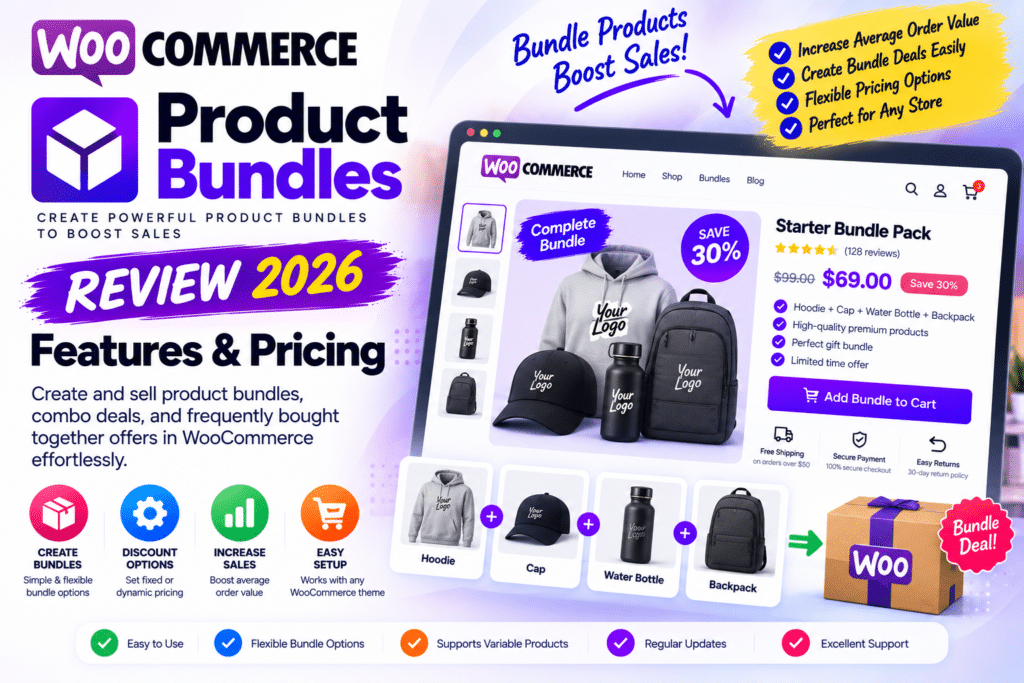
Product Bundles is an official WooCommerce extension designed to combine multiple products into packages while still giving store owners control over pricing, quantities, inventory, shipping, and optional items.
At $79 per year, is WooCommerce Product Bundles worth using in 2026?
Let’s look at its features, pricing, use cases, and limitations.
Quick Verdict
Editorial Rating: 4.7/5
WooCommerce Product Bundles is a strong option for stores that want to sell kits, discounted packages, frequently bought together sets, assembled products, or customizable boxes.
Its biggest advantage is that bundled items remain real WooCommerce products. This makes it far more useful for inventory-based bundles than simply creating one new product called “Starter Pack.”
It isn’t the right choice for every configurable product, though. Complex step-by-step product builders may be better suited to WooCommerce Composite Products.
What Is WooCommerce Product Bundles?
WooCommerce Product Bundles is an official Woo extension for grouping existing WooCommerce products and selling them together.
You can create bundles using products such as:
- Simple products
- Variable products
- Subscription products
- Physical products
- Virtual products
- Downloadable products
A basic bundle might look like:
Photography Starter Kit
Camera Body
- Lens
- Camera Bag
- Memory Card
Instead of asking customers to find each item separately, you can present the package as one product offer.
WooCommerce Product Bundles Pricing in 2026
At the time of this review, WooCommerce lists Product Bundles at:
1-Year Plan: $79
2-Year Plan: $126.40 at the currently displayed multi-year discount.
The subscription includes updates and customer support, and WooCommerce currently advertises a 30-day money-back guarantee.
Pricing and promotions can change, so always check the official listing before purchasing.
Create Fixed Product Bundles
One of the simplest uses is creating a fixed package.
Imagine you sell coffee equipment.
Instead of selling everything separately, create:
Coffee Starter Kit
Coffee Beans
- Grinder
- French Press
- Measuring Spoon
Customers can purchase the entire kit from one product page.
This is useful for starter packs, gift sets, product collections, and complementary products.
Bundle Variable Products
Product Bundles can also include variable products.
For example, a clothing bundle might contain:
T-Shirt
Hoodie
Cap
Customers can potentially choose from the variations you’ve made available within the bundle.
You can also limit which variations are available when a variable product is included.
This gives you more flexibility than creating a bundle containing only simple products.
Configurable Quantities
Not every bundle needs fixed quantities.
You can configure minimum and maximum quantities for bundled items.
For example:
Build Your Snack Box
Choose:
Minimum: 6 items
Maximum: 12 items
Customers can then create their box within the rules you define.
WooCommerce also supports limits on the combined quantity of items inside a bundle.
This makes Product Bundles useful for certain pick-and-mix experiences.
Optional Products
Some bundled items can be optional.
Imagine you’re selling a camera kit:
Camera – Required
Lens – Required
Memory Card – Optional
Tripod – Optional
Customers get the core bundle while still being able to add relevant extras.
This can also help increase average order value without forcing every customer to purchase every accessory.
Bundle Pricing
Product Bundles provides flexible pricing options.
You can give the entire bundle a base price, preserve individual item pricing, or combine pricing approaches depending on the setup.
For example:
Individual products:
Camera: $500
Lens: $200
Bag: $70
Total separately:
$770
Bundle price:
$699
Now customers have a clear reason to purchase the complete package.
Individual Item Pricing
Sometimes you don’t want one static price.
Instead, the final bundle price may need to reflect the products and quantities selected by the customer.
Product Bundles can preserve the prices of individually priced bundled items.
This is particularly useful for configurable bundles where optional products or quantities affect the total.
Bundle Discounts
Discounting is one of the most obvious reasons to create product bundles.
For example:
Buy Separately: $120
Bundle Price: $99
The customer saves $21 while your store sells several products in one transaction.
WooCommerce also supports bulk quantity discount workflows for Product Bundles, allowing larger quantities to receive higher discounts in suitable configurations.
Inventory Management
Inventory is where Product Bundles becomes more useful than manually creating a fake “bundle product.”
The components inside a bundle can remain inventory-managed products.
Imagine:
Camera Stock: 10
Lens Stock: 4
Bag Stock: 20
Even though you have plenty of cameras and bags, you can’t realistically sell more than four complete bundles if each requires one lens.
Product Bundles can work with the stock status of bundled items, making inventory management more practical.
Low-Stock Bundles
WooCommerce’s current Product Bundles feature set also includes tools for identifying bundles affected by insufficient component stock.
This is particularly useful for larger stores where the same product may appear inside several different bundles.
Instead of manually checking every package, inventory information can help identify which bundles require attention.
Shipping Options
Bundles can contain physical products with different shipping requirements.
Product Bundles provides shipping controls that let stores determine how bundled products should be handled.
For example, an assembled product might ship as one package.
Another bundle might contain products that need to retain their individual shipping properties.
This flexibility is useful for stores selling furniture, equipment kits, computers, gift boxes, and other multi-product packages.
Physical, Virtual and Downloadable Bundles
Product Bundles isn’t limited to physical products.
You can also create virtual or downloadable bundles.
For example:
Designer Resource Pack
Photoshop Templates
- Icons
- Fonts
- Social Media Templates
A customer purchases the bundle and receives access to the included downloadable products.
This makes Product Bundles relevant to digital-product stores as well as traditional WooCommerce shops.
Frequently Bought Together Offers
Product Bundles can also be used to create packages around products customers commonly purchase together.
For example:
Laptop
- Laptop Bag
- Wireless Mouse
- USB-C Hub
You can present the combination as a useful package rather than relying entirely on separate cross-sell suggestions.
A small bundle discount can make the package more attractive.
Assembled Products
Another interesting use case is selling products made from multiple inventory-managed components.
For example:
Office Desk Package
Desk Frame
- Desktop
- Drawer Unit
- Cable Tray
The finished item is sold as a bundle while its components can still participate in inventory management.
WooCommerce specifically positions Product Bundles for both assembled and unassembled product packages.
Product Bundles vs Grouped Products
WooCommerce already includes Grouped Products for free.
So why pay for Product Bundles?
| Feature | Product Bundles | Grouped Products |
|---|---|---|
| Group products | Yes | Yes |
| Fixed bundle price | Yes | Limited |
| Bundle discounts | Strong | Limited |
| Optional products | Yes | Basic |
| Quantity rules | Strong | Basic |
| Inventory-aware components | Yes | Yes |
| Custom bundle experience | Strong | Basic |
| Cost | Premium | Free |
Grouped Products can work well when you simply want several related products displayed together.
Product Bundles is more appropriate when the group itself needs to behave like a structured product package.
Product Bundles vs Product Add-Ons
These extensions solve different problems.
Product Bundles combines actual WooCommerce products.
Product Add-Ons adds personalization fields or paid extras to a product.
For example:
Camera + Lens + Bag
→ Product Bundles
Engraving Text + Gift Message + File Upload
→ Product Add-Ons
This distinction matters because Product Add-Ons aren’t separate inventory-tracked products.
If the extra option is a real product that needs stock management, Product Bundles is usually more appropriate.
Product Bundles vs Composite Products
This is another important distinction.
Product Bundles works well when you already know the products that belong in a package or want to provide controlled optional items and quantities.
Composite Products is designed for more complex product-building experiences.
For example:
Starter Camera Kit
Camera + Lens + Bag
Product Bundles makes sense.
Build Your Own Computer
Choose CPU →
Choose Motherboard →
Choose RAM →
Choose Storage →
Choose Graphics Card
Composite Products is usually the more appropriate solution.
WooCommerce currently lists Composite Products separately at $149/year.
Product Bundles + WooCommerce Subscriptions
Product Bundles can also participate in subscription-oriented setups.
For example:
Monthly Coffee Box
Coffee Beans
- Snack
- Brewing Accessory
WooCommerce documents integration possibilities with its subscription ecosystem, including All Products for WooCommerce Subscriptions.
This can create powerful recurring product-box workflows.
However, subscription bundles are more complex than normal bundles, so thoroughly test pricing, renewals, inventory, and shipping before launch.
Product Bundles + Product Add-Ons
Product Add-Ons can add personalization to a bundle.
For example:
Premium Gift Box
Chocolate
- Coffee
- Candle
- Greeting Card
Then Product Add-Ons could collect:
Recipient Name
Gift Message
Delivery Instructions
This combination is useful when you’re selling actual bundled products but also need customer-entered personalization.
Product Bundles + CartFlows
Bundles can also fit into a sales funnel.
For example:
Landing Page → Bundle Offer → Checkout → Upsell → Thank You
Instead of discounting one product, you can create a higher-value bundle and promote it through a dedicated CartFlows campaign.
Again, the bundle itself doesn’t guarantee better conversions.
The offer still needs to make sense to customers.
Analytics
WooCommerce’s current Product Bundles feature set includes revenue analytics for bundles.
This is useful because bundle performance shouldn’t be judged purely by how many units sell.
You may want to understand whether bundles are increasing:
- Revenue
- Average order value
- Product movement
- Accessory sales
- Inventory turnover
Use real store data to decide which packages deserve continued promotion.
Mobile Experience
A configurable bundle can become complicated on a small screen.
Always test:
Bundle → Product Options → Quantity → Add to Cart → Cart → Checkout
Keep product choices understandable and avoid displaying an overwhelming number of options.
A bundle that requires customers to scroll through dozens of confusing selections may reduce the convenience you were trying to create.
Performance
Product Bundles adds additional product relationships and calculations to WooCommerce.
Most stores should focus on the overall environment rather than assuming the extension alone determines performance.
Pay attention to:
- Hosting
- Number of plugins
- Product database size
- Product images
- Page builder
- Dynamic pricing
- Cart fragments
- Caching
- Checkout optimization
Large stores with thousands of products and complicated bundles should test performance before deploying changes to production.
Pros and Cons
Pros
- Official WooCommerce extension
- Fixed product packages
- Variable products supported
- Configurable quantities
- Optional bundled items
- Flexible bundle pricing
- Product discounts
- Inventory-aware components
- Flexible shipping options
- Physical and digital bundles
- Suitable for assembled products
- Frequently bought together use cases
- WooCommerce ecosystem integrations
- Bundle analytics
- Useful for increasing average order value
Cons
- Annual subscription
- More complex than Grouped Products
- Not ideal for highly complex step-by-step configurations
- Advanced subscription bundles may require additional extensions
- Large configurable bundles can overwhelm customers
- Requires careful stock and shipping configuration
Who Should Use WooCommerce Product Bundles?
Product Bundles is particularly useful for:
- WooCommerce retailers
- Electronics stores
- Fashion stores
- Gift shops
- Digital product sellers
- Subscription-box businesses
- Furniture stores
- Food businesses
- Photography stores
- Computer/accessory shops
- Stores selling starter kits
- Businesses offering frequently purchased combinations
If customers commonly purchase several of your products together, creating a structured bundle is worth considering.
Who Should Skip It?
You probably don’t need Product Bundles if you only want to display a few related products together.
WooCommerce’s free Grouped Products functionality may be sufficient for simple requirements.
Likewise, stores building complicated products with dependent component choices should investigate Composite Products instead.
Use the simplest tool that handles your actual workflow.
Is WooCommerce Product Bundles Worth It in 2026?
At $79 per year, WooCommerce Product Bundles offers strong value for stores that genuinely use product packages.
Its usefulness goes beyond simply applying a discount.
You can combine real WooCommerce products, preserve their inventory behavior, control quantities, offer optional items, create physical or digital packages, and configure pricing and shipping.
For stores selling starter kits, gift sets, assembled products, or frequently purchased combinations, these features can justify the annual cost.
Final Verdict
Overall Rating: 4.7/5
Bundle Management: 4.9/5
WooCommerce Integration: 4.9/5
Pricing Flexibility: 4.8/5
Inventory Management: 4.8/5
Customization: 4.7/5
Ease of Use: 4.4/5
Value: 4.7/5
WooCommerce Product Bundles is one of the more practical WooCommerce extensions for stores looking to sell several existing products as one structured offer.
The $79 annual price makes the most sense when bundling is part of your actual merchandising strategy rather than something you’ll use for only one product.
Frequently Asked Questions
How much does WooCommerce Product Bundles cost?
As of September 2026, WooCommerce lists Product Bundles at $79 for one year. A two-year option is currently displayed at $126.40. Pricing and promotions can change.
Can I bundle variable products?
Yes. Product Bundles supports simple and variable products, and WooCommerce also documents support for subscription products.
Does Product Bundles manage inventory?
Bundled products can remain inventory-managed WooCommerce products, making the extension useful for packages built from real stock items.
Can customers choose products inside a bundle?
Product Bundles supports configurable quantities and optional items. For complex step-by-step product configuration, Composite Products may be more appropriate.
Can I discount a product bundle?
Yes. Product Bundles supports pricing and discount workflows for creating discounted packages and bulk offers.
What’s the difference between Product Bundles and Product Add-Ons?
Product Bundles combines actual WooCommerce products. Product Add-Ons adds options such as text, file uploads, checkboxes, and other personalization fields to an existing product.
Is Product Bundles better than Composite Products?
They solve different problems. Product Bundles is suited to packages, kits and controlled bundles. Composite Products is designed for more complex products where customers select components step by step.